Impact analysis with AI: What I learned about my own work
I used AI to analyse my impact over the last six months. What went well, what did not, why your data foundation matters more than the tool and where AI leads you astray.
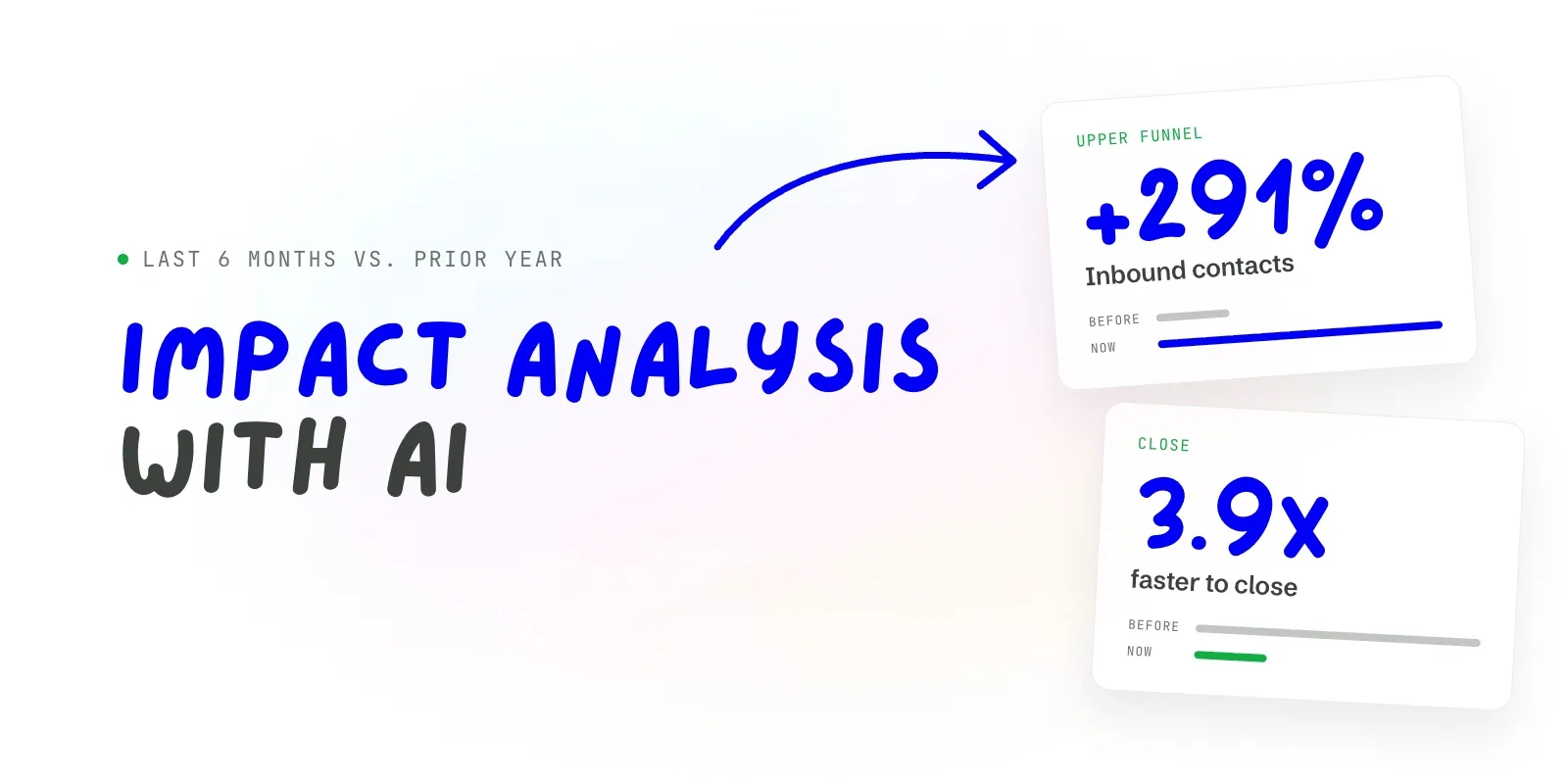
Do you know your impact on the business?
For a long time, I didn't know mine. 🫠
I asked myself that question a lot. But I could never really answer it:
- Missing data
- Poor documentation
- Fear of the truth
Today, knowing my impact matters a lot to me. As a freelancer just as much as a full-time employee. If you don't know what your work achieves, you can't deliberately make it better.
So I looked at the last six months and compared them with the same months a year earlier. With AI. Here's what came out of it, and what I learned along the way.
From a whole weekend to 10 minutes
Two years ago, an analysis like this would have cost me an entire weekend: pulling exports, building spreadsheets, pivot tables, debugging formulas.
Today, AI does it for me in about 10 minutes. What a time to be alive 🕺
But: it doesn't work because AI can do magic. It works because the foundation is right.
- AI is part of the data infrastructure: It's connected to every important data point, from the CRM to the campaigns. No exports, no CSVs.
- The data is clean: clear definitions, maintained fields and a structure you can understand even if you didn't build it yourself.
- I ask the questions: in plain language, for example: "How have inbound contacts, first meetings and new deals developed compared with last year?" The AI does the maths, I challenge it.
A good data foundation means good analyses. A poor one means fast but wrong analyses.
What went well
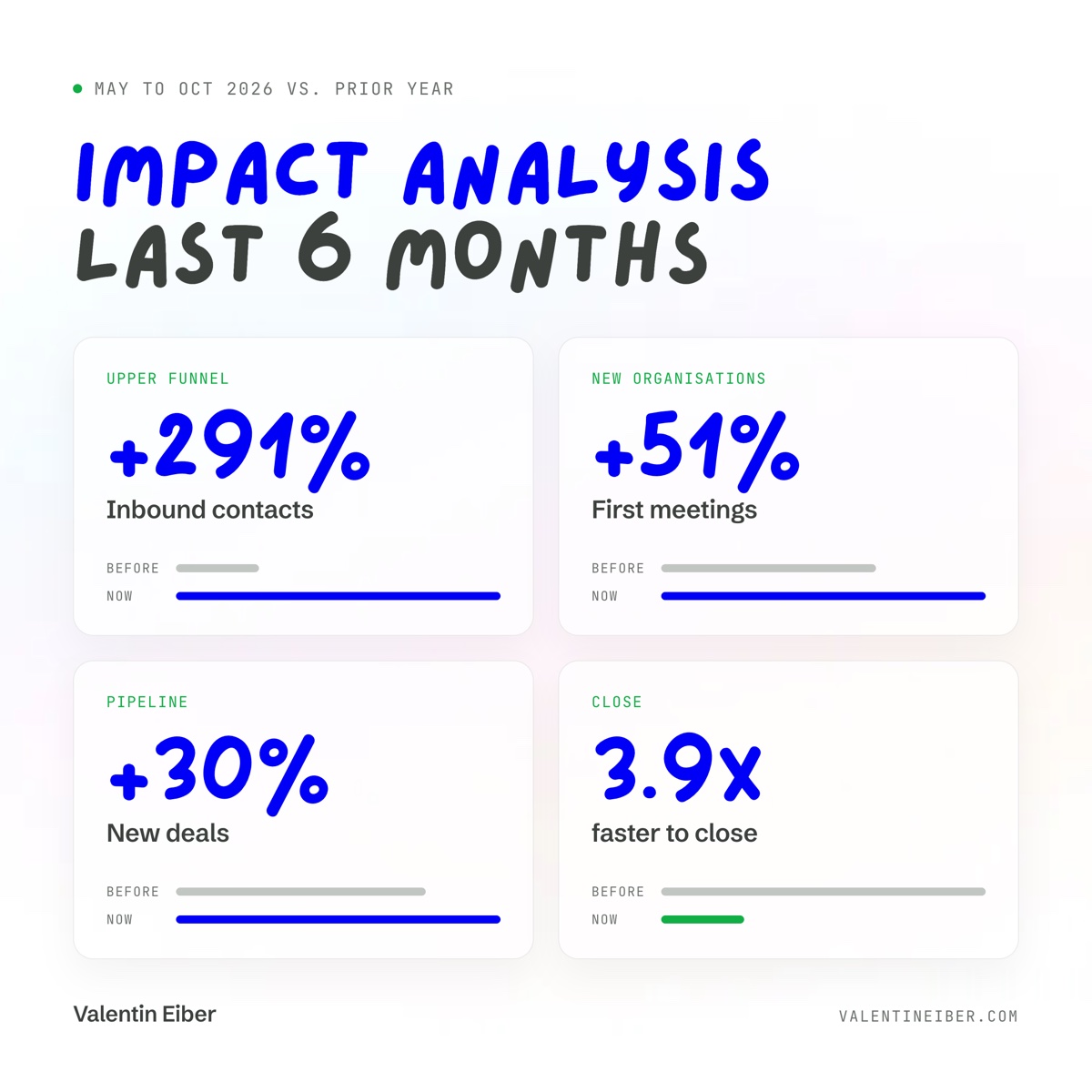
- +291% inbound contacts: Almost four times as many people reach out to us on their own, through the website, landing pages, content and meeting booking.
- +51% first meetings with new organisations: Agencies, events, campaigns and targeted lists for the sellers are paying off.
- +30% new deals: More conversations turn into more real opportunities.
- 3.9x faster to close: The time from creating a deal to closing it has dropped significantly, even without the small account-management deals.
On top of that, there are more than 50 automations in HubSpot that route leads, trigger follow-ups and report every week.
What didn't go well yet
What didn't go so well is just as interesting to me.
More inbound, more conversations and more deals don't automatically mean more closed deals. The top of the funnel has filled up a lot. The path to closed won hasn't caught up to the same extent yet.
No reason to play down the wins. But it's the clearest pointer to where I need to focus next.
Where AI leads you astray
Now the part hardly anyone talks about. AI makes analysis incredibly fast. But it makes it just as fast to massage the numbers. Three traps I fell into myself:
- Cherry-picking the time frame: My first draft happily mixed time frames. Some metrics over twelve months, others over just the last three. Looked great. Over twelve months, though, one metric was actually slightly down. The fix: one time frame for everything, with the same season on both sides.
- Mix effects: Deals closing faster? That can also be because there are more small deals with a short cycle. So I took them out. The effect held, but that's something you have to check, not assume.
- CRM clean-ups: If you tidied up old deals last year and marked them as lost, you pushed last year's win rate down. The new one then looks better than it is. That's why the win rate isn't in my graphic.
AI calculates what you ask it to. Whether the comparison is fair, it won't check on its own. That's still your job.
The other danger: losing focus
With AI, almost anything can suddenly be built. A new automation here, a dashboard there, another workflow for the edge case. Feels productive. But it isn't always.
- Sprawl: More than 50 automations are great, as long as someone keeps track of them. Without documentation and clear ownership, you're just building the next black box.
- Busy instead of effective: The easier something is to build, the more important the question of whether it should be built at all.
- Prioritisation beats speed: AI makes you faster. You still have to run in the right direction yourself.
That's exactly what an impact analysis is good for: it shows which of the many things you built actually move the needle.
What's on my agenda now
Because I know the weak spots, this is on my agenda:
- Transparency across all teams and units: Where are things going well, where do they get stuck, where do we need to follow up? Everyone should be able to see that at any time, not just me.
- Raise the top of funnel to closed won rate: Raising CVRs means improving lead quality, improving processes, using AI more efficiently, team enablement and individual coaching.
- Scale ToFu further with AI and automation: Build content systems, raise outreach quality and improve timing, so the funnel fills up even more.
My biggest learning: foundation first, then AI
The tool isn't the bottleneck. The data foundation is. Whether you want to analyse your own impact or that of the whole company:
- Data quality: Duplicate contacts, empty fields and deals nobody has touched in months distort every analysis.
- Structure: consistent definitions for pipeline, lifecycle stages and sources. What is a lead, what is a first meeting, what is a deal?
- Connection: Connect AI to every important data point, not just a single export.
- A fair comparison: one time frame for everything, take out mix effects, look at the uncomfortable numbers.
- Derive an agenda: An analysis without next steps is just self-congratulation.
None of this happens alone, of course. It takes a team that tries out new ideas and questions them critically. Luckily, I work with exactly those kinds of people. 🫶
And you? Do you look at your impact regularly?
If you're struggling with this kind of analysis, for yourself or for your company, because the data is scattered, messy or not connected: get in touch. I'll help you build the foundation for it.